1. Colour reports appearance—not laboratory concentration
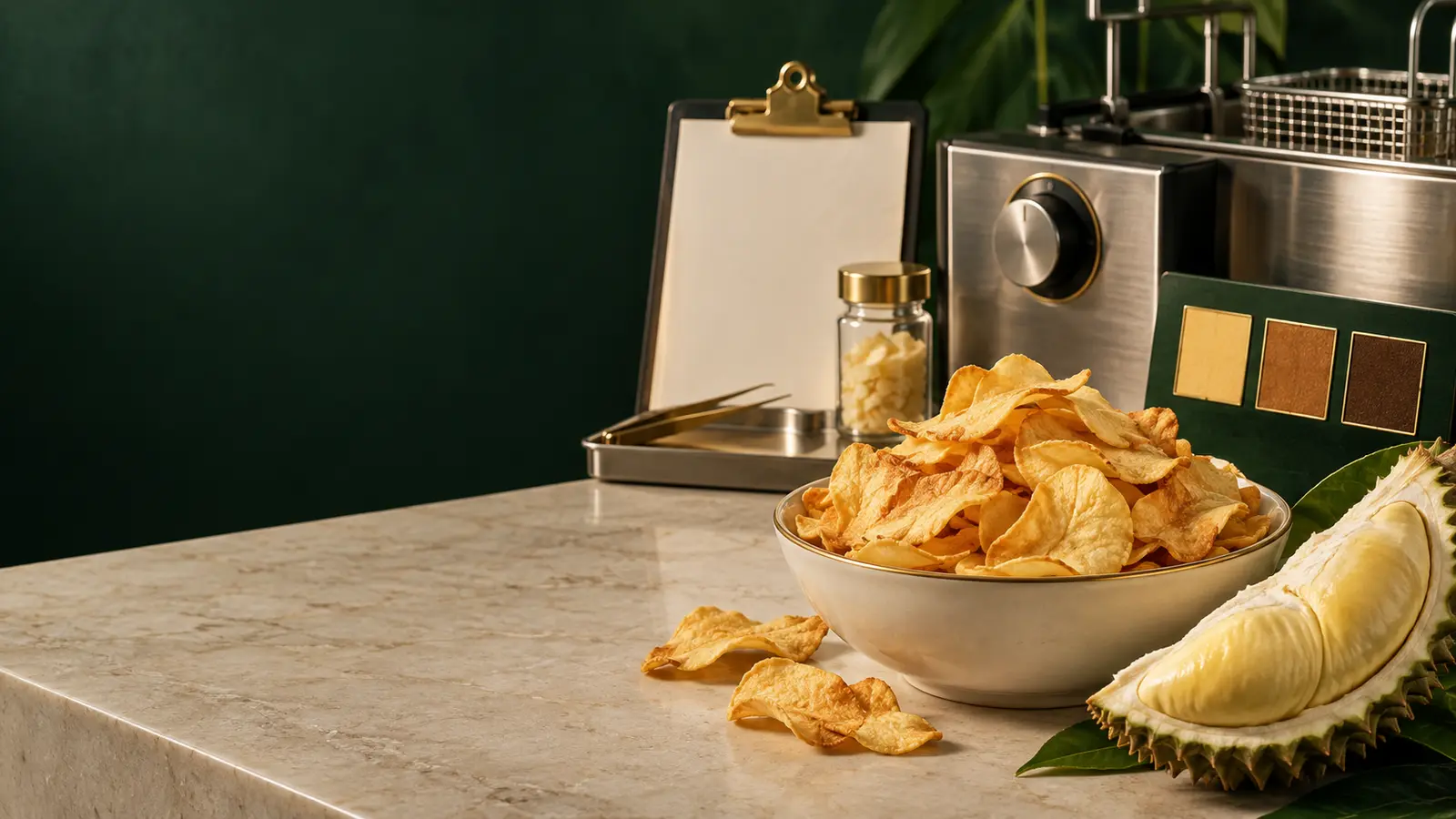
Colour can reveal fryer consistency and excessive heating, but a similar shade may come from different ingredients, slice thicknesses and thermal histories. A colour strip should not be converted into a chemical assurance.
Record colour together with time, temperature, mass change and lot identity, then use an analytical result with clear sample identity to answer the acrylamide question.
2. Formation begins with raw materials and heat
Codex CXC 67-2009 describes acrylamide as forming mainly from asparagine and reducing sugars through the Maillard reaction during high-temperature, low-moisture processing. FDA likewise identifies frying, roasting and baking as more likely formation routes than boiling or steaming.
That mechanism justifies a risk assessment; it does not show that every durian variety, maturity stage or process behaves alike. Evidence must come from the actual material and finished food.
3. A durian lot should trace back to origin
Variety, orchard source, maturity, holding and storage may alter the material before frying. The process file should connect supplier, orchard or collection point, receipt date, raw-material lot and acceptance checks.
Thai origin adds useful GEO context when the place and records are verifiable, but a province name or orchard story does not replace a finished-product result.
4. Recipe and slice preparation can change the answer
Slice thickness, washing or soaking, coatings, sugars and processing aids affect the surface, heat transfer and precursors. Even a small formula change may invalidate an earlier conclusion.
Codex calls for measures to be tested on the operator's own product and assessed for side effects on nutrition, sensory quality, microbiological safety and other process contaminants.
5. The fryer needs an actual history—not only a set point
A displayed set point may not equal oil temperature through a run after product is loaded. Time, batch load, flow, slice thickness, oil condition and endpoint should be recorded for the production lot.
Colour can become a studied guardrail, but its limitations must be stated. No shade should be translated into a numeric concentration without paired evidence.
6. EU benchmark categories and monitoring lists are different
Regulation (EU) 2017/2158 establishes measures and benchmarks for named categories including potato products, cereal products, coffee and baby foods. Recommendation (EU) 2019/1888 identifies additional foods for monitoring, including vegetable crisps/fries and dried fruits.
Those lists do not automatically classify fried durian or make a potato-crisp benchmark applicable. The operator and importer should confirm the product's characteristics, classification, destination and rules in force with the relevant specialist or authority.
7. A seven-layer Acrylamide Process Evidence File
This framework gives the factory, brand and importer one evidence structure. It is not a standard or certificate.
- Product scope: SKU, recipe, intended use, market and classification basis
- Raw-material identity: variety, origin, maturity, supplier and receipt lot
- Preparation record: slice thickness, washing, soaking, coating and ingredients
- Thermal process: fryer, oil, load, actual time–temperature history and endpoint
- In-process signals: colour, moisture, texture and studied alert limits
- Laboratory trail: sampling plan, sample identity, method, report and trend
- Decision lifecycle: release, deviation, corrective action, formula change and legal review
8. Claim boundary
This is an editorial framework for structuring questions and evidence—not a product-specific risk assessment, legal opinion or benchmark for fried durian.
Siam Diamond Journal does not claim that Siam Diamond manufactures fried durian, holds acrylamide results, uses a particular mitigation, complies in a named market or has been certified by any cited authority.